
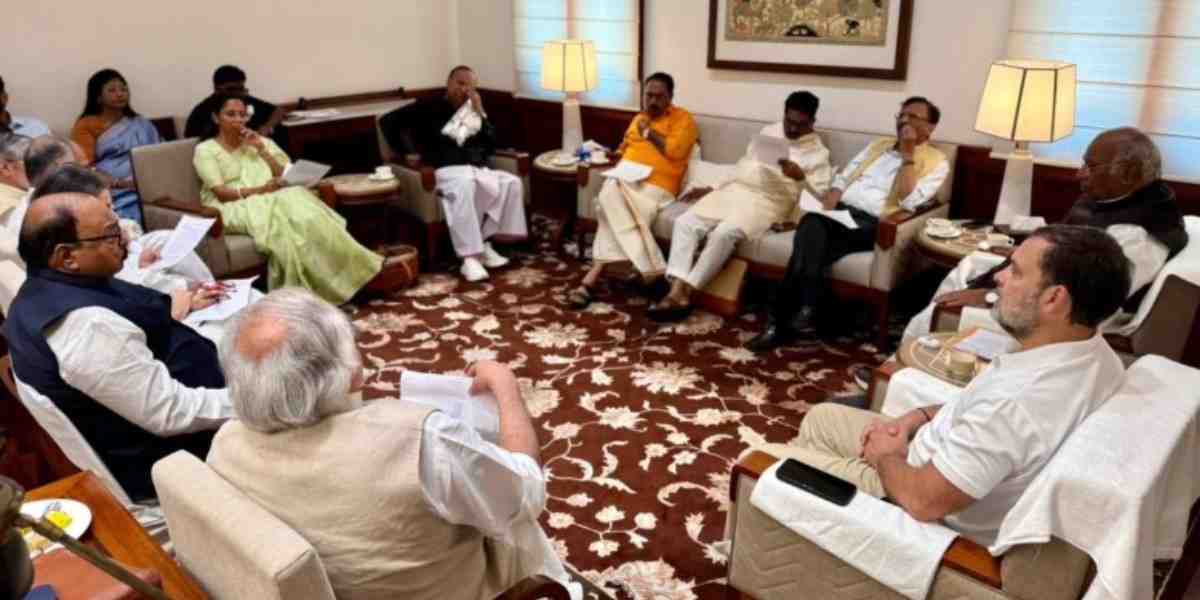
The women reservation delimitation bill has emerged as a central issue in the ongoing special session of Parliament, with the INDIA bloc expressing clear support for women’s reservation while opposing the proposed delimitation exercise.
Leaders from multiple opposition parties have raised concerns about linking the implementation of women’s quota with the redrawing of parliamentary constituencies, calling it a politically sensitive move.
Key Highlights
- INDIA bloc supports women’s reservation in principle
- Strong opposition to delimitation exercise
- Debate intensifies during Parliament session
- Concerns raised over representation and timing
Opposition’s Stand on the Bill
The INDIA bloc has taken a unified position on the women reservation delimitation bill, stating that while they fully support increasing women’s representation, they oppose the way the proposal is being implemented.
Opposition leaders have argued that linking reservation to delimitation could delay its rollout or alter political representation across states. They have called for immediate implementation of women’s quota without conditions tied to constituency changes.
What Is the Delimitation Issue?
Delimitation refers to the process of redrawing electoral boundaries based on population data. Under the current proposal, the Lok Sabha could see a significant increase in seats, potentially changing the balance of representation among states.
The women reservation delimitation bill connects the implementation of 33% reservation for women to this process, which is expected after the next Census.
Critics argue that such linkage complicates what is otherwise a widely supported reform.
Why Opposition Is Concerned
Opposition leaders believe that the delimitation exercise could disproportionately affect certain regions, particularly southern states, by altering seat distribution.
They argue that the women reservation delimitation bill should not be used as a mechanism that may indirectly shift political power. Concerns have also been raised about fairness and federal balance.
Some leaders have described the delimitation proposal as politically motivated, while reiterating their commitment to women’s representation.
Government’s Position
The central government has maintained that the women reservation delimitation bill is aimed at ensuring both gender representation and updated electoral fairness.
Officials have indicated that reservation will be implemented after delimitation to ensure proper allocation of seats. The government views the two processes as interconnected steps toward strengthening democratic representation.
Context: Women’s Reservation in India
The women’s reservation framework proposes 33% seats for women in the Lok Sabha and state assemblies. The law was passed earlier, but its implementation is tied to delimitation and updated census data.
The women reservation delimitation bill is part of a broader effort to operationalise this long-pending reform, which has been debated for decades.
Currently, women’s representation in Parliament remains relatively low, making the proposed quota a significant step toward gender parity.
Broader Political Reactions
The debate around the women reservation delimitation bill has seen varied reactions across political parties. While most parties support reservation, disagreements remain over timing and execution.
Regional leaders have expressed concerns about how delimitation could impact their states, adding complexity to the discussion.
The issue has become a focal point of political discourse, reflecting deeper questions about representation and governance.
Public Impact
The outcome of the women reservation delimitation bill will have far-reaching implications. If implemented, it could significantly increase women’s participation in legislative bodies.
At the same time, changes in constituency boundaries could influence electoral dynamics, making this a critical moment for India’s democratic structure.
What Happens Next
The bill is expected to undergo detailed debate in Parliament, followed by voting. Discussions are likely to focus on whether reservation and delimitation should be linked or treated separately.
The final decision on the women reservation delimitation bill will shape the roadmap for future elections, particularly the 2029 Lok Sabha polls.
Conclusion
The women reservation delimitation bill has brought both consensus and conflict into focus. While there is broad agreement on empowering women through reservation, disagreements over delimitation continue to drive political debate.
As Parliament deliberates, the challenge will be to balance representation, fairness, and timely implementation of one of India’s most significant electoral reforms.(With Inputs from H.S)
Inputs & Images courtesy: Hindusthan Samachar (H.S)
Also read: Complete List: American Music Awards 2026 Nominees Led by Taylor Swift, BTS and Global Artists
Add News Pixel as a preferred source on Google – Click Here
Edited By- E. Lakshmi Tejasri
Last Updated on: Thursday, April 16, 2026 2:00 pm by E. Lakshmi Tejasri | Published by: E. Lakshmi Tejasri on Thursday, April 16, 2026 2:00 pm | News Categories: India

Leave a Reply