
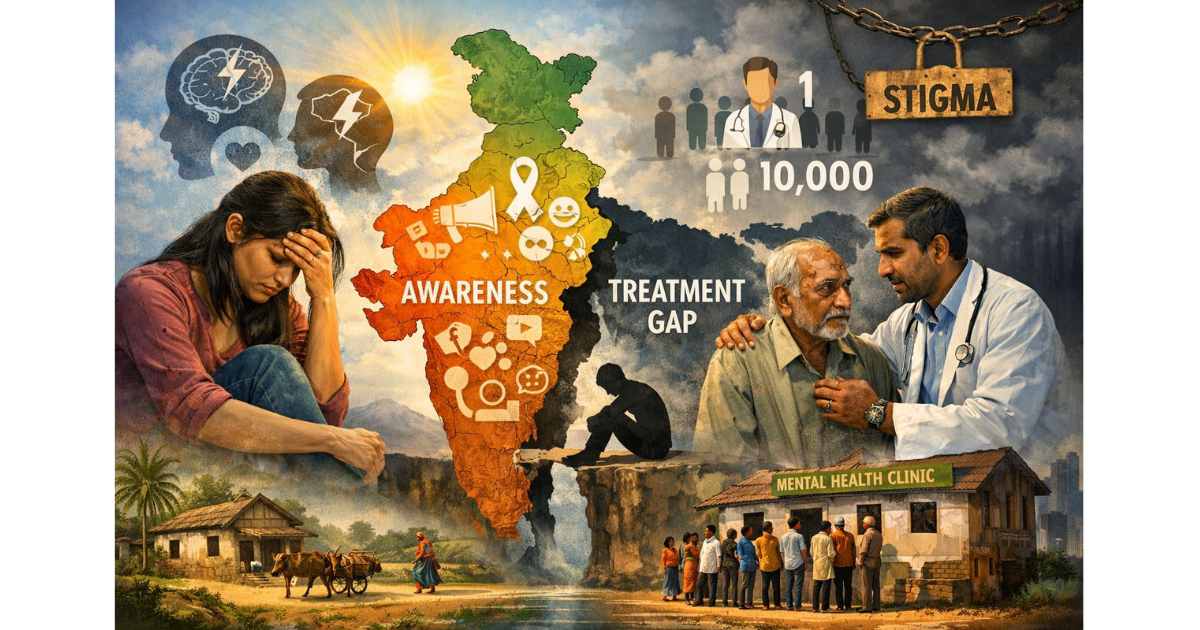
In recent years, India has seen a remarkable shift in how mental health is discussed, acknowledged, and acted upon — from public policy platforms to everyday conversations in homes, schools, and workplaces. Mental health, once shrouded in silence and stigma, is increasingly recognized as a cornerstone of individual well‑being and national development. However, despite this growing awareness, access to appropriate care remains deeply unequal and inadequate — a paradox that has profound implications for India’s social fabric, economy, and future generations.
The Awareness Uprising: From Silent Suffering to Open Conversations
Mental health awareness in India has expanded dramatically over the past decade. Campaigns powered by NGOs, media, educators, and policymakers are challenging deep‑rooted misconceptions that mental illness is a personal weakness or spiritual failing. Influencers and celebrities have publicly shared their journeys with anxiety, depression, and bipolar disorder, helping normalize discussions that were previously taboo. Schools and universities are increasingly incorporating psychosocial well‑being into their campuses, and digital platforms offer anonymity and support to young people hesitant to seek face‑to‑face help.
Government messaging reflects this shift. The Press Information Bureau has underscored that mental well‑being encompasses emotional, social, cognitive and physical capabilities — not just the absence of illness — reinforcing a holistic definition essential for public understanding.
In urban workplaces, progressive employers are investing in employee assistance programs and mental health initiatives, viewing psychological well‑being as integral to productivity and retention. For many young Indians — today’s largest demographic block — mental health is no longer a fringe concern but an essential part of life planning, career choices, and relationships.

Treatment Gaps: Awareness Rising, But Care Has Not Kept Pace
Yet for all the progress in awareness, the treatment gap — the divide between recognition of mental health needs and access to qualified care — remains alarmingly wide. Experts at the Indian Psychiatric Society’s 77th Annual Conference sounded the alarm in early January, reporting that over 80–85% of individuals with mental health conditions in India do not receive timely or appropriate treatment.
This gap is not merely a statistic — it represents millions of lives interrupted by depression, anxiety, bipolar disorder, schizophrenia, and other conditions that become more entrenched, severe, and fatal without early intervention. Across India, families grapple with crises that often go unrecognized until they escalate, leading to lost productivity, fractured relationships, and in the worst cases, suicide.
A National Mental Health Survey underscores the severity of the issue: India faces one of the widest treatment gaps globally, with the majority of people suffering from common mental disorders not seeking or receiving formal care.
Barriers to Care: Stigma, Scarcity and Structural Shortfalls
Despite awareness campaigns clearing some cultural hurdles, long‑standing barriers still obstruct meaningful access to care:
1. Persistent Stigma and Misunderstanding — Deep‑rooted social stigma remains perhaps the most formidable obstacle. Fear of judgment from family, employers, and communities discourages many from seeking help, even when they recognize something is wrong. Mental illness is still frequently framed as a character flaw rather than a medical condition requiring evidence‑based intervention.
2. Shortage of Mental Health Professionals — India’s healthcare system is drastically under‑resourced for mental health. The country has far fewer psychiatrists, psychologists and psychiatric nurses than recommended by global norms — limiting availability of care, especially outside large metropolitan centers.
3. Inequitable Infrastructure — Most mental health facilities are concentrated in urban settings, leaving rural and semi‑urban communities severely underserved. With nearly 70% of the population living outside major cities, access hurdles range from long travel distances to lack of transport and financial constraints.
4. Policy and Funding Gaps — While India’s Mental Healthcare Act, 2017 enshrines the right to mental health care, implementation has been slow and underfunded. Programs such as Tele‑MANAS and the District Mental Health Programme are steps forward but require scaling and sustained investment to match the burgeoning need.
The Human Toll: Stories Behind the Numbers
Behind these figures lie countless personal stories. A student battling depression without access to on‑campus counseling delays help until symptoms become debilitating. A factory worker experiencing panic attacks avoids seeking care due to fear of losing income. An elderly person’s signs of depression are dismissed as “normal aging,” leaving them isolated and untreated. In each case, the gap between awareness and care reveals a profound human cost.
Schools and universities are beginning to respond. In Lucknow, Babasaheb Bhimrao Ambedkar University plans to hire psychological counselors to support students grappling with academic stress and personal issues, reflecting a recognition that mental health services are essential to education. Similarly, the Central Board of Secondary Education has mandated counseling and wellness staff to support socio‑emotional development in schools nationwide.
Yet, ambitious policies also face practical hurdles. In Ludhiana, low pay has left most school counselor posts vacant, underscoring the challenge of translating policy into service delivery.
Economic and Social Stakes: Why It Matters Now
Mental health is no longer a niche health conversation — it has national and economic implications. Poor mental health is linked to lost productivity, increased healthcare costs, substance misuse, and higher rates of unemployment. For a country like India, with its demographic dividend and aspirations for rapid economic growth, untreated mental illness represents both a moral and economic burden.
Recognizing this, the Economic Survey 2024–25 described mental health as integral to sustaining India’s demographic dividend. Without strategic investments in mental health services, the country risks undermining the very human capital it aims to empower.
Looking Ahead: From Awareness to Action
India stands at a critical inflection point. Awareness campaigns have succeeded in moving mental health from the shadows into mainstream discourse, but the journey from recognition to access — to real, effective, equitable care — is far from complete.
Experts stress the urgency of integrating mental health services into primary healthcare, boosting funding, expanding the mental health workforce, and addressing social determinants of mental well‑being. Increased investment, community‑based services, digital outreach, and robust education programs will be essential to closing the treatment gap and ensuring that awareness translates into accessible, quality care.
Ultimately, a society that values mental health is one that acknowledges the full spectrum of human experience — not as an afterthought, but as a fundamental right and necessity. For India, the stakes are not just medical or economic — they are deeply human.
Also read : https://republicpost.in/what-you-need-to-know-about-food-prices-supply-chains-and-inflation-pressures/
Add newspixel.in as a preferred source on google – click here
Last Updated on: Thursday, January 22, 2026 1:07 pm by News Pixel Team | Published by: News Pixel Team on Thursday, January 22, 2026 1:07 pm | News Categories: News
About The Author

Comment here