
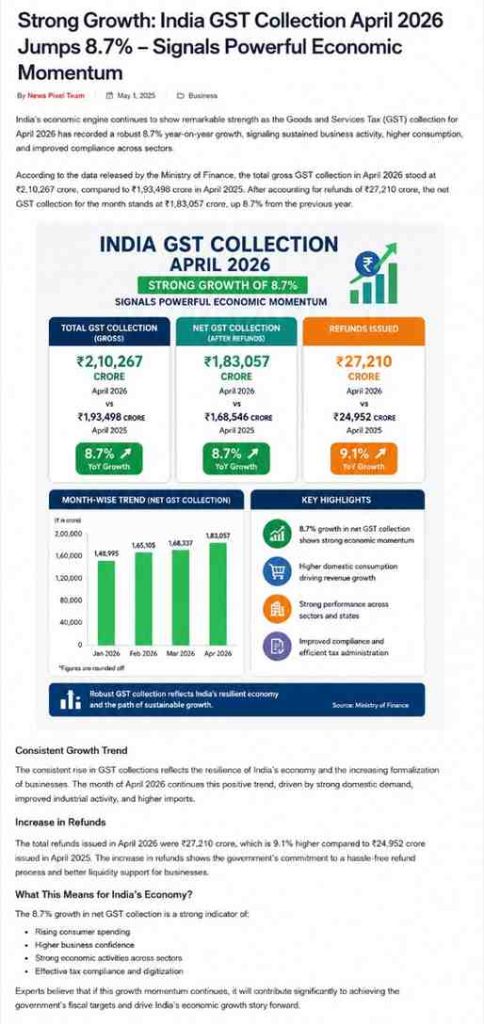
India’s economic momentum continues to show strength as the India GST collection April 2026 recorded an impressive 8.7% year-on-year growth. The latest figures reflect a steady rise in domestic consumption, improved tax compliance, and sustained business activity across sectors.
The Goods and Services Tax (GST), introduced in 2017, has become a key indicator of economic health, and this latest surge points to a resilient and expanding economy.
What the Latest GST Data Shows
The India GST collection April 2026 growth highlights a positive trend in tax revenues, driven largely by increased consumer spending and better compliance.
Key highlights include:
- 8.7% increase compared to April 2025
- Strong contribution from both goods and services sectors
- Stable inflow from domestic transactions
This consistent rise reinforces confidence in India’s economic recovery and growth trajectory.
Role of Domestic Consumption
A major driver behind the India GST collection April 2026 surge is strong domestic demand. Consumer spending has remained robust across categories such as:
- FMCG and retail goods
- Automobiles and electronics
- Services including hospitality and travel
Higher consumption directly translates into increased tax collection, reflecting a healthy demand environment.
Improved Compliance and Digital Systems
Another key factor supporting the India GST collection April 2026 is improved tax compliance. The government and the Goods and Services Tax Council have implemented several measures to streamline the system.
These include:
- E-invoicing and digital tracking
- Stricter enforcement against tax evasion
- Simplified return filing processes
Such initiatives have significantly enhanced transparency and efficiency.
Sector-Wise Contributions
The India GST collection April 2026 data indicates balanced contributions from multiple sectors:
- Manufacturing continues to drive goods-related taxes
- Services sector shows steady growth
- MSMEs contribute significantly due to improved compliance
This diversified contribution reduces dependence on any single sector.
Economic Implications
The rise in India GST collection April 2026 has broader implications for the economy:
- Higher government revenue supports public spending
- Increased investor confidence in economic stability
- Positive outlook for GDP growth
It also reflects the success of structural reforms implemented over the past few years.
Comparison with Previous Trends
Compared to earlier months, the India GST collection April 2026 growth maintains a consistent upward trajectory.
While fluctuations are normal, sustained growth over time indicates:
- Stable economic recovery
- Strengthening tax base
- Improved business sentiment
Challenges Ahead
Despite the positive numbers, maintaining the India GST collection April 2026 momentum will require addressing certain challenges:
- Ensuring compliance among smaller businesses
- Managing inflationary pressures
- Strengthening enforcement mechanisms
Continuous policy support will be crucial.
What Lies Ahead
The outlook for India GST collection April 2026 remains optimistic. With ongoing digital reforms and rising consumption, collections are expected to remain strong in the coming months.
Key areas to watch include:
- Festive season demand
- Export performance
- Policy changes by the GST Council
Conclusion
The India GST collection April 2026 surge of 8.7% underscores the resilience and strength of India’s economy. Driven by robust domestic consumption and improved compliance, the latest figures signal a positive growth trajectory.
As India continues to strengthen its tax ecosystem and economic fundamentals, GST collections will remain a key barometer of progress and stability.
Add News Pixel as a preferred source on Google – Click Here
Edited By- E. Lakshmi Tejasri
Last Updated on: Wednesday, May 6, 2026 3:23 pm by E. Lakshmi Tejasri | Published by: E. Lakshmi Tejasri on Friday, May 1, 2026 6:45 pm | News Categories: Finance, India

Leave a Reply