

India’s higher education system is entering a decisive phase as the National Education Policy (NEP) 2026 guidelines begin to reshape how colleges admit students. Moving away from a degree-centric mindset that has dominated for decades, the policy places skills, aptitude, and multidisciplinary learning at the heart of admissions. For millions of students, parents, and institutions, this marks not just a procedural change, but a cultural shift in how merit and potential are defined.
From Marksheets to Mindsets
For generations, college admissions in India have largely revolved around board exam marks, entrance test scores, and rigid cut-offs. The NEP 2026 guidelines challenge this narrow framework by encouraging institutions to look beyond rote performance and focus on what students can actually do. Skills such as critical thinking, problem-solving, communication, creativity, and digital literacy are now positioned as key indicators of readiness for higher education.
This transition reflects a growing recognition that high marks do not always translate into real-world competence. As industries rapidly evolve due to technology and automation, colleges are being nudged to admit students who demonstrate adaptability and practical understanding rather than just academic recall.
Holistic Admissions Take Centre Stage
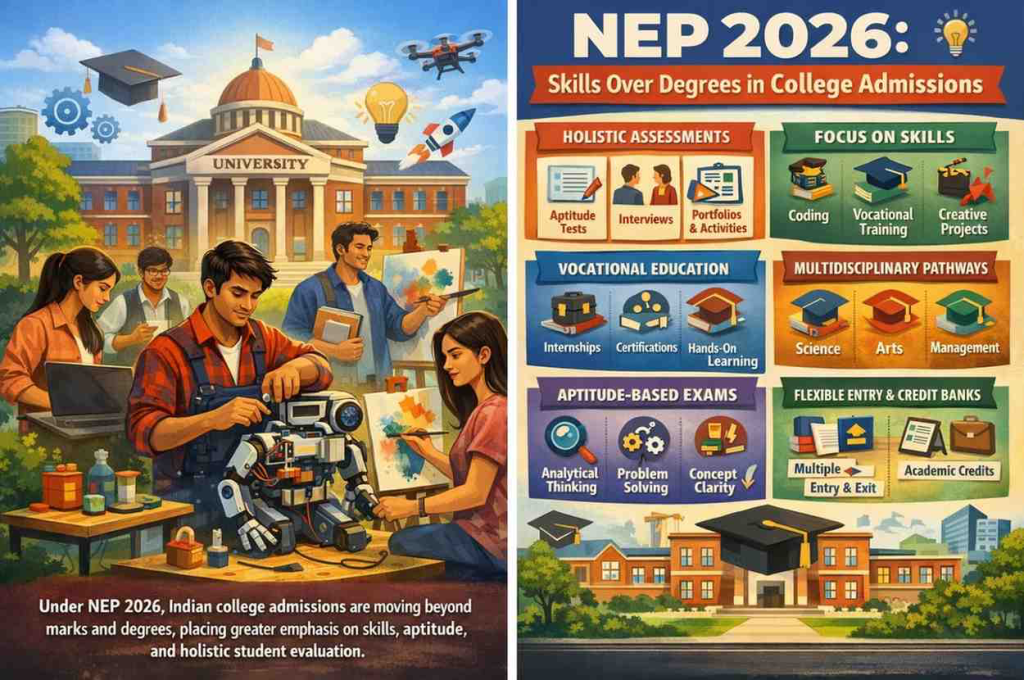
One of the most significant changes under NEP 2026 is the push for holistic admissions. Universities and colleges are encouraged to evaluate students using multiple parameters, including aptitude tests, interviews, portfolios, project work, and extracurricular achievements. This approach aims to capture a fuller picture of a student’s interests and abilities.
For students, this means that a single exam will no longer define their academic future. Those with strengths in areas such as coding, design, research, entrepreneurship, sports, or community service may now find greater recognition during the admission process. It also opens doors for learners from diverse educational backgrounds, including vocational and skill-based streams.
Greater Role for Vocational and Skill-Based Learning
The NEP 2026 guidelines strongly emphasise the integration of vocational education with mainstream higher education. Colleges are encouraged to value prior learning, internships, apprenticeships, and skill certifications while admitting students. This is a major shift in a system that traditionally placed vocational education on a lower pedestal.
As a result, students who have pursued skill courses after school or alongside their formal education may no longer feel disadvantaged. Instead, their hands-on experience can become an asset during admissions, particularly for applied and professional programmes.
Multidisciplinary Pathways and Flexible Entry
Another key impact of the new guidelines is the encouragement of multidisciplinary learning. Admissions are expected to become more flexible, allowing students to move across disciplines without being locked into narrow streams chosen at the age of 16 or 17. A student with a background in science may be able to pursue humanities or management-related programmes, provided they demonstrate aptitude and interest.
This flexibility also extends to multiple entry and exit options, supported by academic credit banks. Admissions decisions, therefore, are increasingly aligned with long-term learning pathways rather than one-time degree outcomes.
Entrance Exams with a New Purpose
While entrance examinations will continue to play a role, their nature is expected to change. Instead of testing memorisation, the NEP 2026 guidelines encourage aptitude-based assessments that measure analytical thinking, conceptual clarity, and problem-solving skills. Common entrance tests may coexist with institution-specific evaluations, giving colleges more autonomy in selecting students aligned with their academic vision.
This shift could reduce the pressure-cooker culture associated with high-stakes exams and coaching centres, although its success will depend on how fairly and transparently these new assessments are implemented.
Challenges for Institutions and Students
Despite its progressive intent, the transition to skill-focused admissions is not without challenges. Many colleges, especially in smaller towns, may struggle to design and implement holistic evaluation systems due to limited resources and trained faculty. Ensuring consistency and fairness across institutions will also be a major concern.
For students, the change demands a different kind of preparation. Building skills, portfolios, and practical experience requires guidance and exposure that may not be equally available to all. Bridging this gap will be crucial to prevent new forms of inequality from replacing old ones.
What This Means for the Future of Higher Education
The NEP 2026 guidelines signal a long-term transformation rather than an overnight overhaul. By prioritising skills over degrees at the admission stage, the policy seeks to align education with employability, innovation, and lifelong learning. If implemented effectively, it could produce graduates who are not only qualified on paper but also capable in practice.
For India’s youth, this shift offers an opportunity to redefine success beyond marks and ranks. For colleges, it is a call to reimagine their role as nurturers of talent rather than mere credentialing bodies. As the new admission cycles unfold under NEP 2026, the real test will lie in translating policy vision into classroom and campus reality.
Add newspixel.in as a preferred source on google – click here
Last Updated on: Wednesday, January 28, 2026 1:26 pm by News Pixel Team | Published by: News Pixel Team on Wednesday, January 28, 2026 1:26 pm | News Categories: News
About The Author

Comment here