
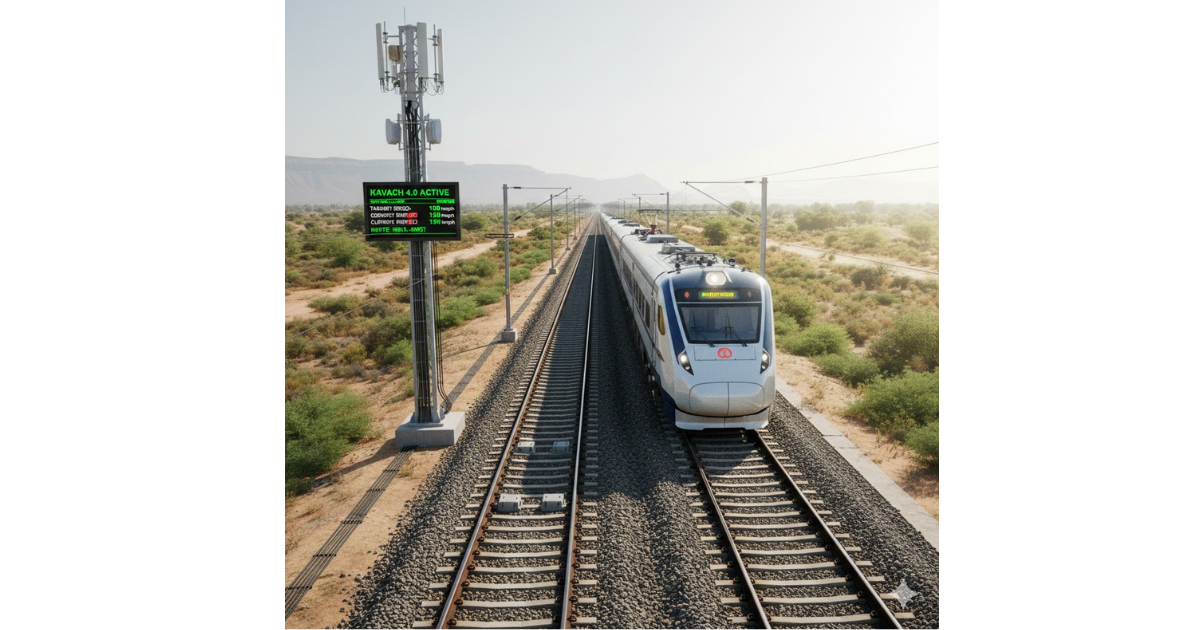
The landscape of Indian rail safety is undergoing a paradigm shift as the Ministry of Railways aggressively pivots toward the full-scale operationalization of Kavach 2.0—the indigenous Automatic Train Protection (ATP) system. After missing the initial December 2025 deadline due to the sheer technical complexity of the integration, the government has now formally set 2026 as the definitive year for a major rollout across the nation’s highest-traffic corridors. This move marks a transition from localized trials to a network-wide safety standard designed to eliminate human error, the primary cause of signal-related accidents.
Critical High-Traffic Routes Slated for Commissioning
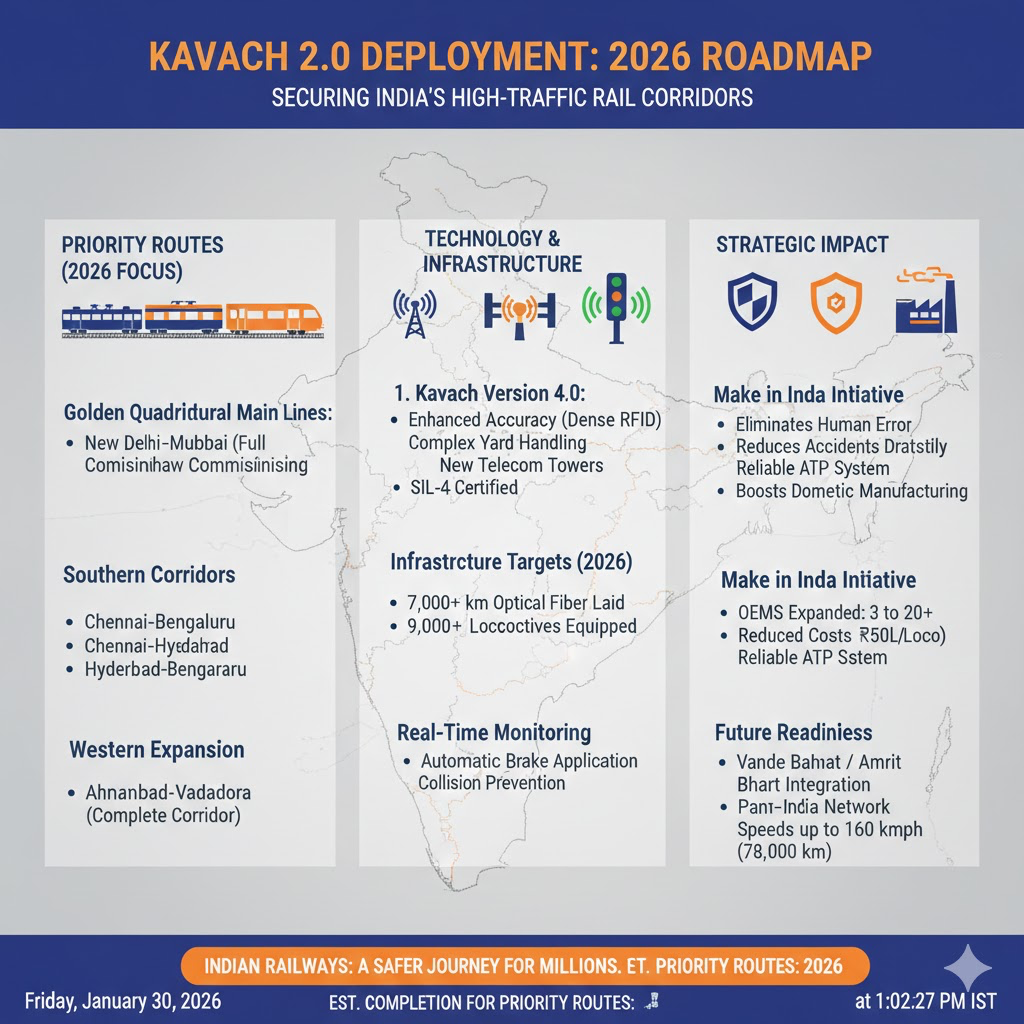
The centerpiece of this year’s deployment remains the “Golden Quadrilateral” and its “Golden Diagonal” connections, which carry the lion’s share of India’s passenger and freight traffic. Leading the list are the New Delhi–Mumbai and New Delhi–Howrah (Kolkata) corridors. These two routes are the busiest in the country, and their full commissioning is viewed as the ultimate litmus test for Kavach 4.0—the latest technical iteration of the system.
Beyond these primary arteries, work has been greenlit for the high-density sections connecting Chennai, Bengaluru, and Hyderabad. Specifically, the South Central Railway—often the testing ground for Kavach—is expected to see complete integration on its arterial lines. In the western region, the Ahmedabad–Vadodara section recently saw a major breakthrough with the commissioning of the 96-km Bajwa–Ahmedabad stretch, serving as a blueprint for rapid installation in other high-consequence zones.
Technical Evolution: Why Version 4.0 Matters
The deployment this year isn’t just about more kilometers; it’s about more capable technology. The transition to Version 4.0 represents a significant upgrade over previous iterations like Version 3.2. This latest software is designed to handle more complex station yards and provides better location accuracy through a denser network of Radio Frequency Identification (RFID) tags and telecom towers.
The infrastructure requirements for this year are staggering. The Ministry has already laid over 7,000 kilometers of optical fiber cable and installed 800 telecom towers to support the real-time communication between the “Station Kavach” and the “Loco Kavach.” For passengers, this means a system that can automatically apply brakes if a loco pilot misses a signal or if two trains are detected on a collision course, operating with a Safety Integrity Level-4 (SIL-4) certification—the global gold standard for rail safety.
Overcoming the Vendor Bottleneck
One of the primary reasons for the 2026 timeline shift was a lack of industrial capacity. Historically, only three companies were approved to manufacture and install the highly specialized equipment. However, 2026 is expected to be a breakout year for the “Make in India” ecosystem. The number of approved Original Equipment Manufacturers (OEMs) has already grown to five, and railway officials are optimistic that this number could cross 20 by the end of the year.
This expansion of the vendor base is critical to the Ministry’s target of equipping an additional 9,000 locomotives this year. By diversifying the supply chain, the Railways aims to lower the cost of installation—currently estimated at approximately ₹50 lakh per kilometer for track-side equipment and ₹80 lakh per locomotive—while simultaneously increasing the pace of deployment to cover the 15,000 route-kilometers currently under various stages of execution.
The Long-Term Vision for a Collision-Free Network
As the 2026 deployment progresses, the focus is also shifting toward the future integration of Kavach with other modern technologies like the Vande Bharat Express and the newly inaugurated Amrit Bharat trains. The goal is to create a seamless, interoperable safety web where the system can handle trains running at speeds up to 160 kmph without compromising safety.
While the New Delhi–Mumbai and New Delhi–Howrah routes remain the priority, the successful rollout this year will provide the momentum needed to eventually cover the entire 78,000-kilometer broad-gauge network. For a nation that relies on its railways as its lifeline, the 2026 “Kavach year” isn’t just about technology; it’s about a fundamental promise of safer journeys for millions of daily commuters.
Add newspixel.in as a preferred source on google – click here
Last Updated on: Friday, January 30, 2026 1:06 pm by News Pixel Team | Published by: News Pixel Team on Friday, January 30, 2026 1:06 pm | News Categories: News
About The Author

Comment here