
What Is the 2026 Blood Moon?
The 2026 Blood Moon refers to a spectacular total lunar eclipse in 2026, during which the Moon will appear deep red or copper-colored in the night sky. A Blood Moon happens when the Earth passes directly between the Sun and the Moon, blocking direct sunlight and casting a shadow on the Moon.
Unlike a solar eclipse, a lunar eclipse is safe to watch with the naked eye and can be visible across large parts of the world depending on the timing and geographic location. Skywatchers, astronomers, and astrophotographers eagerly anticipate this rare celestial event.
What Is a Total Lunar Eclipse?
A total lunar eclipse occurs when the Moon moves completely into the Earth’s umbra (the darkest part of its shadow). This alignment happens during a full moon when the Sun, Earth, and Moon are perfectly lined up.
There are three main stages:
- Penumbral Eclipse – The Moon enters Earth’s outer shadow.
- Partial Lunar Eclipse – A portion of the Moon moves into the darker umbra.
- Total Lunar Eclipse – The entire Moon is covered by Earth’s shadow, creating the dramatic red appearance known as a Blood Moon.
The 2026 total lunar eclipse is expected to be one of the most talked-about astronomical events of the year.
The Science Behind the Red Color: Rayleigh Scattering
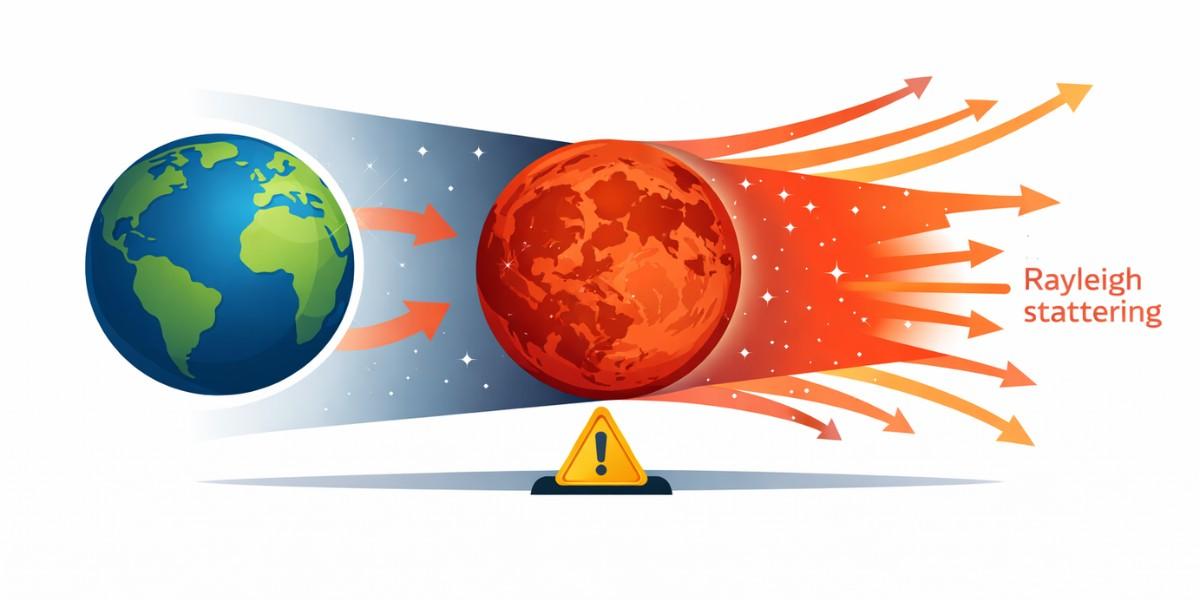
The red color of a Blood Moon is caused by a scientific phenomenon called Rayleigh scattering.
Rayleigh scattering occurs when sunlight passes through Earth’s atmosphere. Shorter wavelengths of light (blue and violet) scatter more easily, which is why the sky appears blue during the day. However, during a lunar eclipse:
- Sunlight passes through Earth’s atmosphere.
- Blue light gets scattered in all directions.
- Red and orange wavelengths bend (refract) around Earth.
- These red wavelengths reach the Moon’s surface.
As a result, the Moon appears red instead of disappearing completely.
This is the same process that creates red and orange sunsets. During a lunar eclipse, the Moon is essentially lit by the glow of every sunrise and sunset happening around Earth at that moment.
Why Some Blood Moons Appear Darker Than Others
Not all Blood Moons look the same. The brightness and color intensity depend on:
- Atmospheric conditions
- Dust and pollution levels
- Volcanic activity
- Cloud cover in Earth’s atmosphere
If there are large amounts of dust or volcanic ash in the atmosphere, the Moon may appear darker or even brownish-red instead of bright copper.
When and Where to Watch the 2026 Blood Moon
The visibility of the 2026 Blood Moon will depend on your geographic location. Typically, total lunar eclipses can be seen from entire continents if the Moon is above the horizon at the time of totality.
To watch the eclipse:
- No special equipment is required.
- Binoculars or telescopes enhance the experience.
- Find a dark location away from city lights.
- Check the exact timing for your region.
Astronomy websites and observatories will release precise timing schedules closer to the date.
Cultural and Historical Significance of Blood Moons
Throughout history, Blood Moons have been associated with myths, prophecies, and superstitions. Ancient civilizations often viewed the red Moon as an omen.
Today, scientists understand the astronomical explanation behind the event, yet it continues to fascinate people worldwide due to its dramatic appearance.
Why the 2026 Blood Moon Matters for Astronomy Enthusiasts
The 2026 total lunar eclipse provides:
- A chance for astrophotography
- An opportunity for public skywatching events
- Educational discussions about Earth’s atmosphere
- A real-life demonstration of Rayleigh scattering
It is also a reminder of how interconnected Earth’s atmosphere and space phenomena truly are.
Final Thoughts: A Cosmic Reminder of Earth’s Atmosphere in Action
The 2026 Blood Moon is more than just a beautiful night sky event. It is a powerful demonstration of atmospheric physics, orbital mechanics, and the science of light scattering.
When you look up and see the red Moon, you are witnessing sunlight filtered through Earth’s atmosphere and projected across space — a stunning natural display driven by Rayleigh scattering.
Mark your calendar and prepare to experience one of the most breathtaking astronomical events of 2026.
Also read: Gold vs. Silver Investment: Why Industrial Demand is Changing the Rules in 2026
Add News Pixel as a preferred source on Google – Click Here
Last Updated on: Tuesday, March 3, 2026 5:01 pm by News Pixel Team | Published by: News Pixel Team on Tuesday, March 3, 2026 5:01 pm | News Categories: Latest, Technology

Leave a Reply