

Health awareness in 2026 is undergoing a quiet but meaningful shift. After years dominated by weight loss goals, step counts, and calorie tracking, the wellness conversation is moving toward deeper biological priorities that determine how long, how well, and how independently people live. Muscle health and sleep optimization have emerged as the defining wellness trends of the year, not as fleeting lifestyle fads but as evidence-backed pillars of long-term health that cut across age groups, professions, and fitness levels.
Muscle health is no longer being discussed only in the context of athletes or bodybuilders. Medical research and public health data are making it increasingly clear that skeletal muscle functions as a critical organ system. Healthy muscle mass supports metabolism, stabilizes blood sugar, protects joints, improves balance, and reduces the risk of falls and fractures. In adults over 40, the natural loss of muscle, known as sarcopenia, accelerates if strength training and adequate protein intake are neglected. By 2026, this awareness has filtered into mainstream health messaging, with doctors, insurers, and employers framing muscle maintenance as preventive care rather than optional fitness.
One reason muscle health has become a priority is its strong link to chronic disease prevention. Studies consistently show that individuals with higher muscle mass and strength have lower risks of type 2 diabetes, cardiovascular disease, and insulin resistance, even when body weight remains unchanged. Muscle tissue plays a major role in glucose uptake, making it a powerful regulator of metabolic health. As lifestyle diseases continue to rise globally, especially in urban populations with sedentary routines, maintaining muscle has become a practical defense strategy rather than an aesthetic pursuit.
Another factor driving this trend is the changing demographic profile of the workforce. With people working longer into their 50s and 60s, physical resilience has economic value. Employers are increasingly supporting resistance training programs, ergonomic education, and movement breaks to reduce musculoskeletal issues and absenteeism. In 2026, muscle health is being framed as essential for productivity, mobility, and quality of life, particularly in professions that involve prolonged sitting or repetitive physical tasks.
Parallel to this focus on muscle is the growing recognition that sleep is not passive rest but active biological repair. Sleep optimization has moved far beyond advice to “get eight hours.” Advances in sleep science have revealed how sleep quality, timing, and consistency affect nearly every system in the body. During deep sleep, muscle tissue repairs itself, growth hormone is released, and inflammation is regulated. Poor sleep disrupts these processes, directly undermining muscle recovery, immune function, and mental clarity.
The stress-heavy, screen-driven lifestyle of recent years has made sleep disturbances more common across all age groups. In response, 2026 has seen a shift toward treating sleep as a foundational health behavior rather than something to sacrifice for productivity. Wearable technology, once focused mainly on steps and heart rate, now emphasizes sleep stages, recovery scores, and circadian rhythm alignment. This data-driven approach has helped people understand the direct consequences of irregular sleep patterns on energy levels, mood, and physical performance.
Sleep optimization has also gained attention because of its link to mental health. Chronic sleep deprivation is strongly associated with anxiety, depression, and cognitive decline. In an era where burnout and emotional fatigue are widespread, improving sleep is being promoted as a low-cost, high-impact intervention. Health professionals in 2026 increasingly recommend sleep routines, light exposure management, and digital detox strategies as part of standard wellness advice, alongside diet and exercise.
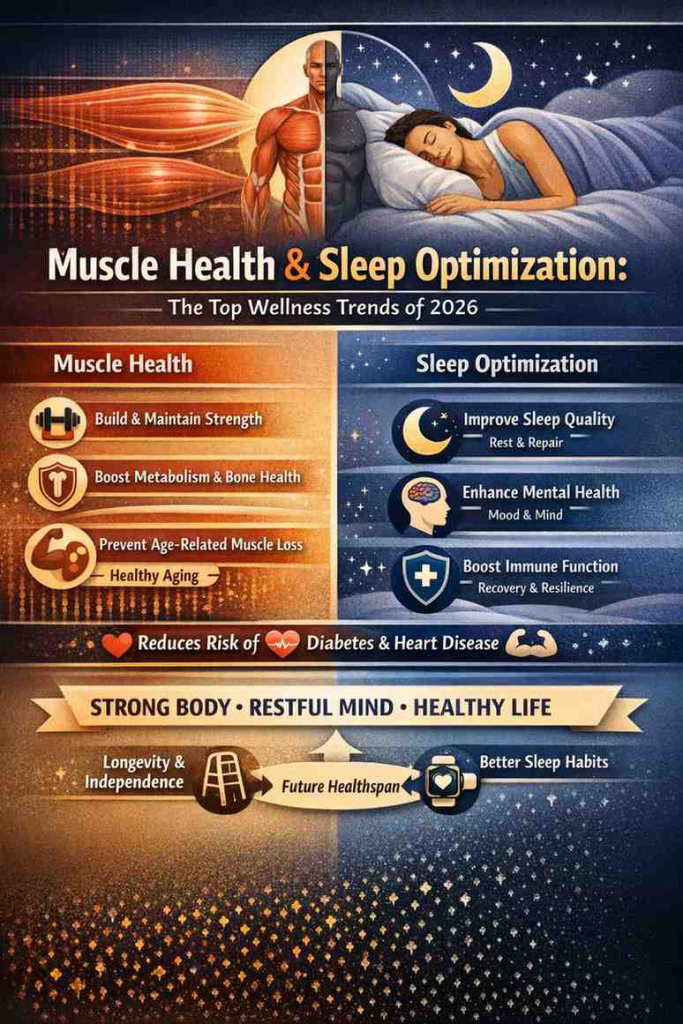
What makes muscle health and sleep optimization especially powerful as combined trends is how deeply interconnected they are. Resistance training improves sleep quality by increasing deep sleep duration and reducing nighttime restlessness. At the same time, adequate sleep enhances muscle recovery, strength gains, and injury prevention. This mutually reinforcing relationship has shifted wellness thinking away from isolated habits toward integrated health systems where daily choices compound over time.
The cultural narrative around aging is also changing, contributing to the rise of these priorities. Longevity is no longer defined only by lifespan but by healthspan, the number of years lived without disability or dependence. Maintaining muscle mass and protecting sleep quality are two of the strongest predictors of functional independence later in life. In 2026, this message resonates not just with older adults but with younger generations who are increasingly focused on future-proofing their health.
Public health campaigns and digital health platforms are reinforcing this shift by simplifying the message. Instead of complex fitness regimes or restrictive diets, the emphasis is on building basic strength, preserving mobility, and respecting the body’s need for rest. This accessibility has helped muscle health and sleep optimization gain traction across socioeconomic groups, making them inclusive wellness goals rather than elite practices.
As health awareness evolves in 2026, the spotlight on muscle and sleep reflects a broader maturity in how wellness is understood. The focus is moving from short-term transformations to sustainable habits that support resilience, energy, and independence across decades. In prioritizing muscle health and sleep optimization, individuals are not just responding to trends but aligning with fundamental biological needs that modern life has long neglected.
Add newspixel.in as a preferred source on google – click here
Last Updated on: Wednesday, February 4, 2026 6:25 pm by News Pixel Team | Published by: News Pixel Team on Wednesday, February 4, 2026 12:22 pm | News Categories: Trending

Leave a Reply