
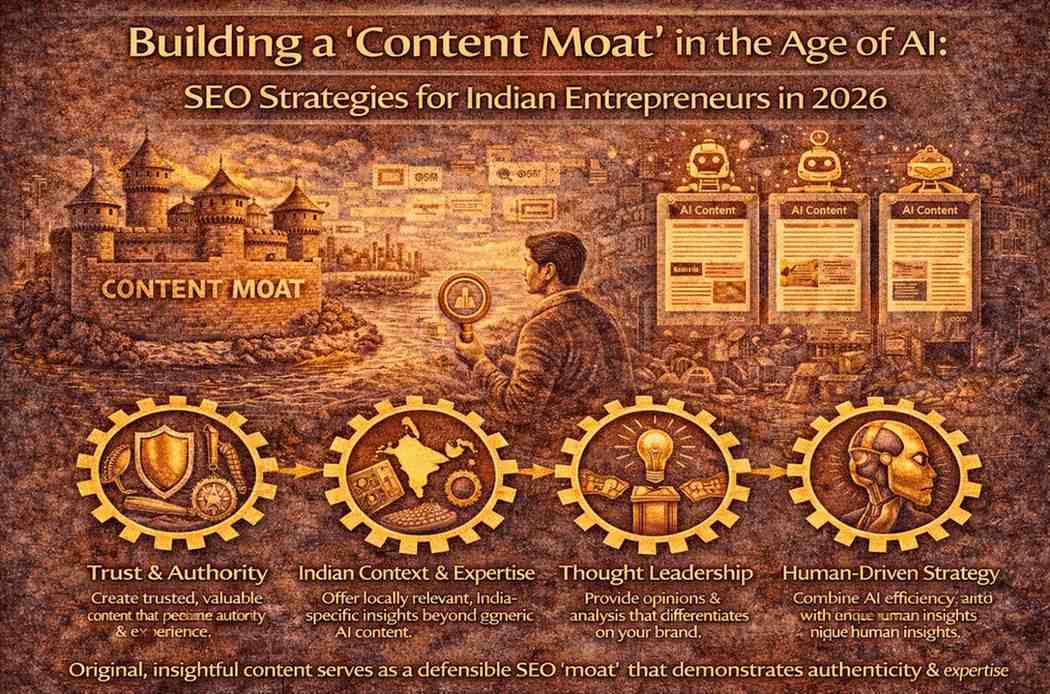
As artificial intelligence reshapes how content is created, discovered, and consumed, Indian entrepreneurs face a new digital reality. AI-generated articles, summaries, and search answers are flooding the internet, making it harder for businesses to stand out using conventional SEO tactics alone. In this environment, building a strong “content moat” — content that is difficult to replicate, deeply valuable, and trusted — has become essential for long-term visibility and growth. For Indian founders in 2026, SEO is no longer just about rankings; it is about authority, originality, and sustained relevance.
Why the Age of AI Has Changed SEO Forever
AI tools have dramatically lowered the barrier to content creation. Businesses can now generate hundreds of articles, product descriptions, and blog posts in a fraction of the time it once took. While this has increased efficiency, it has also led to content saturation and declining differentiation.
Search engines are responding by prioritising quality, credibility, and real-world expertise. Generic, repetitive, or surface-level content is increasingly filtered out. For entrepreneurs, this means that traditional keyword-stuffing or volume-based strategies are no longer sufficient. SEO success now depends on depth, trust, and demonstrable value.
What a ‘Content Moat’ Really Means
A content moat refers to a body of content that competitors and AI tools find difficult to replicate. It is built on original insights, proprietary data, lived experience, and consistent expertise. Unlike generic blogs, moat content reflects a brand’s unique perspective, customer understanding, and industry involvement.
For Indian entrepreneurs, a content moat can be created through long-form explainers, industry-specific insights, case studies, thought leadership, and locally relevant expertise. The goal is to become a primary source of knowledge rather than just another publisher chasing traffic.
Search Engines Are Prioritising Trust and Authority
By 2026, search algorithms are heavily focused on experience, expertise, authority, and trustworthiness. Content that demonstrates first-hand knowledge, credible sourcing, and consistent accuracy is rewarded with visibility across search and discovery platforms.
For founders, this means content should reflect real business experience. Articles written from the perspective of operators, founders, or domain specialists perform better than generic overviews. Search engines increasingly look for signals that content is backed by genuine expertise rather than automated generation.
Original Insights Over Generic Keywords
Keyword research remains relevant, but it has evolved. Instead of targeting broad, high-volume keywords, successful SEO strategies focus on intent-driven, problem-specific queries. Users are searching for nuanced answers, comparisons, and context-rich explanations.
Indian entrepreneurs who share original market insights, customer behaviour trends, regulatory perspectives, or operational learnings are better positioned to capture this intent. Content that answers “why,” “how,” and “what it means” questions creates stronger engagement and longer relevance.
Leveraging Indian Context as a Competitive Advantage
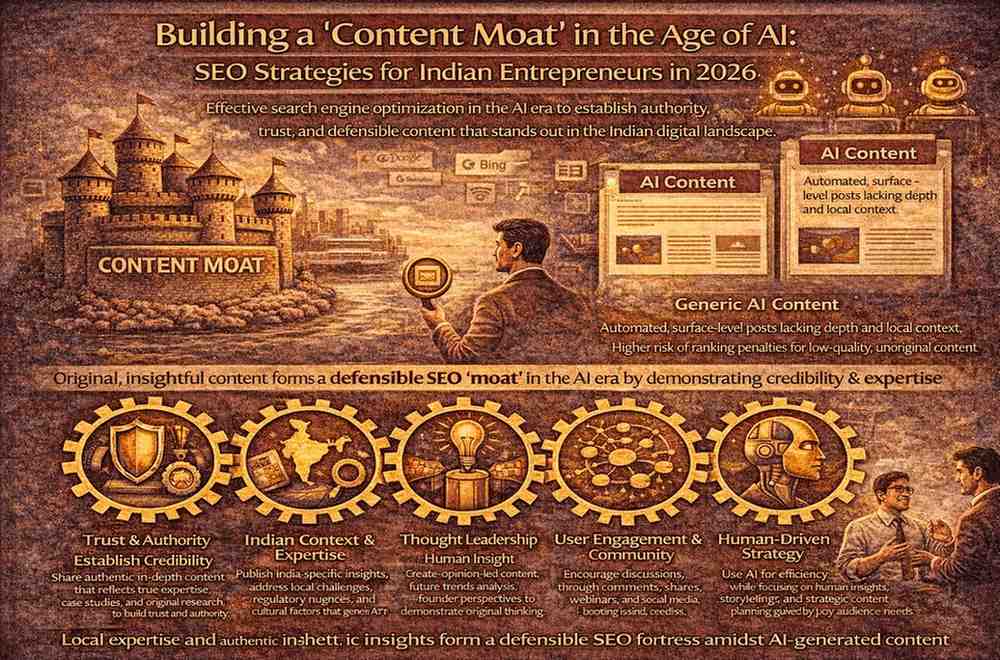
One of the strongest opportunities for Indian entrepreneurs lies in contextual expertise. Global AI-generated content often lacks India-specific nuance, whether related to regulations, consumer behaviour, language diversity, or market dynamics.
Content that addresses Indian use cases, policy environments, regional differences, and local success stories naturally stands out. This localisation strengthens relevance and builds trust with both audiences and search platforms, creating a defensible SEO advantage.
The Role of Thought Leadership in a Content Moat
Thought leadership has become a core SEO asset. Opinion-led content, founder perspectives, and forward-looking analysis help brands establish authority beyond transactional keywords. In an AI-heavy landscape, human perspective is a differentiator.
Entrepreneurs who consistently publish informed viewpoints on industry trends, challenges, and future directions build recognition and recall. Over time, this content attracts organic backlinks, brand searches, and citations — all critical components of a strong content moat.
Community, Credibility, and Engagement Signals
Search engines increasingly consider user engagement and brand signals when ranking content. Articles that spark discussion, are shared within professional communities, or are referenced by credible platforms gain longevity.
Indian founders can strengthen these signals by integrating content with communities, newsletters, webinars, podcasts, and social platforms. When content is actively consumed and discussed by real users, it sends powerful credibility signals that AI-generated mass content cannot easily replicate.
Balancing AI Tools With Human-Led Strategy
AI is not the enemy of SEO, but it must be used strategically. In 2026, successful entrepreneurs use AI to support research, structuring, and optimisation, while ensuring that the core insights remain human-led.
AI can help scale distribution and efficiency, but the strategic layer — understanding audiences, crafting narratives, and offering insight — must remain human-driven. This balance allows businesses to benefit from AI without losing authenticity or trust.
Long-Form, Evergreen Content as a Defensive Asset
In an era of fleeting trends and rapid content churn, long-form evergreen content has become a defensive SEO asset. Deep explainers, guides, and industry primers continue to attract traffic over time, even as algorithms evolve.
For Indian entrepreneurs, investing in fewer but higher-quality pieces delivers compounding returns. These assets form the foundation of a content moat, generating sustained visibility and reducing dependence on constant content production.
Measuring Success Beyond Traffic Metrics
SEO success in 2026 is no longer measured only by page views. Metrics such as time spent, repeat visits, brand searches, lead quality, and influence on conversions matter more than raw traffic numbers.
A strong content moat supports broader business goals — from trust-building and customer education to sales enablement and investor credibility. Entrepreneurs who align SEO strategy with business outcomes gain more durable value from their content investments.
The Road Ahead for Indian Entrepreneurs
Building a content moat in the age of AI is a strategic necessity, not a marketing trend. As automated content becomes ubiquitous, differentiation will come from authenticity, insight, and relevance. Indian entrepreneurs who invest early in authority-driven, context-rich, and experience-backed content will be better positioned to survive algorithm changes and competitive pressure.
In 2026, SEO is no longer about gaming search engines; it is about earning trust. Those who treat content as a long-term asset rather than a short-term growth hack will create visibility that endures — even in an AI-dominated digital landscape.
Add newspixel.in as preferred source on google – click here
Last Updated on: Tuesday, January 27, 2026 11:15 am by News Pixel Team | Published by: News Pixel Team on Tuesday, January 27, 2026 11:15 am | News Categories: India

Leave a Reply